






Atomic Spectroscopy Group
| Head: |
doc. Ing. Antonín Kaňa, Ph.D. |
| Members: |
Ing. Kristýna Lapčíková, Dr. sc. ETH Zürich (mateřská dovolená) |
| PhD students: |
Ing. Hana Kučerová (AK) Ing. Věra Nešporová (obhájila 2024) Ing. Petr Rudolf (AK) |
|
supervisors: AK = doc. Kaňa |
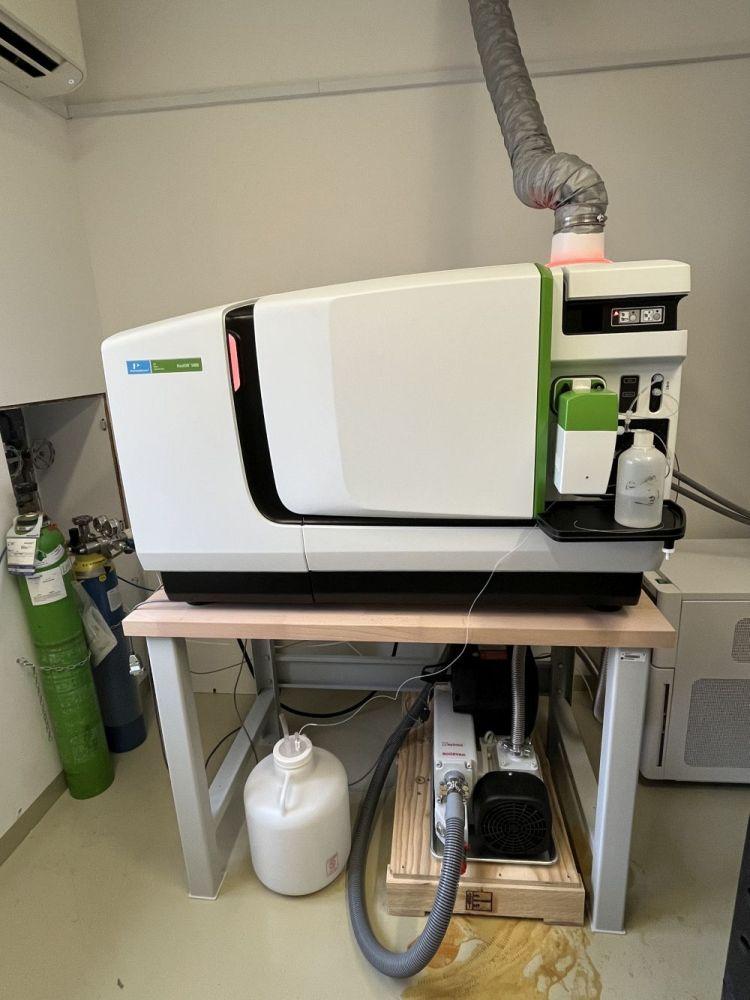
The current equipment includes two inductively coupled plasma mass spectrometers. The older instrument, the Elan DRC-e by PerkinElmer, has excellent performance characteristics and is equipped with a reaction cell to remove interfering polyatomic ions. This device is also used in the education of master's students. Recently, the laboratory has been equipped with a high-end NexIon 350D from PerkinElmer. In addition to enhanced sensitivity, the instrument supports a new so-called universal cell technology. This technology eliminates spectral interference from polyatomic ions by using ammonia as the reaction gas in both the reaction-cell and collision-cell modes. Thanks to the ultra-fast signal measurement capability (minimum signal integration time of 0,01 ms), it is possible to analyze the size of individual nanoparticles.
The laboratory is further equipped with a PerkinElmer liquid chromatograph (LC) and a Speed Wave microwave decomposition device for sample preparation.
Main fields of interest:
Speciation analysis of trace elements in biotic matrices:
- The development of measurement methodologies using LC-ICP-MS on-line connection.
- The analysis of plant extracts and the monitoring of variations in trace-element speciation during vegetation (especially selenium).
- The speciation analysis of arsenic in food.
Application of the ICP-MS method for determination of total element concentration:
- The development, validation, and estimation of uncertainties of determination of trace amounts of metals in biotic matrices by the ICP-MS method.
- The application of the universal cell to remove interfering polyatomic ions.
- Research on the methodology of analysis of solutions with high organic content.
- The determination of trace elements in various matrices, e.g. animal and plant tissues, food and drink, pharmaceuticals, catalysts.
Characterization of inorganic nanoparticles (NP) by single-particle (sp) ICP-MS
- Optimization of measurement procedure
- Analysis of Ag NP in cosmetics
- Analysis of Ag NP in food (in cooperation with the Department of Food Analysis and Nutrition)